MAT040 Beginning Algebra All classes

Introduction to Algebra · Chapter 7

Linear Equations in One Variable

The practice sets below are interactive: the numbers change every time you load the page. Type your answer, press Enter or Check, and use New numbers to practice again.

Examples of linear equations in one variable:

3x+2=177a+4=3a−23x+2=17\qquad\qquad7a+4=3a-2

Steps to solve a linear equation in one variable
Step 1. Simplify each side of the equation as much as possible.
Step 2. Use the addition property of equality to get all the variable terms on one side and the constants on the other, then combine like terms.
Step 3. Use the multiplication property to get the variable by itself.
Step 4. Check your solution.

Example. Solve 3(x+2)=−93(x+2)=-9.

Step 1:3x+6=−9Step 2:3x+6−6=−9−63x=−15Step 3:3x3=−153x=−5Step 4:3(−5+2)=3(−3)=−9 ✓\begin{align*} \text{Step 1:}\quad 3x+6&=-9\\ \text{Step 2:}\quad 3x+6-6&=-9-6\\ 3x&=-15\\ \text{Step 3:}\quad\frac{3x}3&=\frac{-15}3\\ x&=-5\\ \text{Step 4:}\quad 3(-5+2)=3(-3)&=-9\ \checkmark \end{align*}

Example. Solve x2+x6=8\dfrac x2+\dfrac x6=8. Factor out xx using the distributive property:

x⋅12+x⋅16=8x(12+16)=8x(36+16)=8x⋅46=x⋅23=8\begin{align*} x\cdot\frac12+x\cdot\frac16&=8\\ x\left(\frac12+\frac16\right)&=8\\ x\left(\frac36+\frac16\right)&=8\\ x\cdot\frac46=x\cdot\frac23&=8 \end{align*}
x=8⋅32=2⋅2⋅2⋅32=4⋅3=12x=8\cdot\frac32=\frac{2\cdot2\cdot2\cdot3}{2}=4\cdot3=12
Practice 1

Evaluating Variable Expressions

The Distributive Property

5(x+3)=5x+5⋅3=5x+155(x+3)=5x+5\cdot3=5x+15
−14(8x+12)=−8x4−124=−2x−3-\frac14(8x+12)=-\frac{8x}4-\frac{12}4=-2x-3

Combining Like Terms

Example. Simplify 23x−2+13x+7\dfrac23x-2+\dfrac13x+7. Group like terms:

23x+13x−2+7=(23+13)x+5=33x+5=x+5\frac23x+\frac13x-2+7=\left(\frac23+\frac13\right)x+5=\frac33x+5=x+5

Example. −2(3y+4)+5=−6y−8+5=−6y−3-2(3y+4)+5=-6y-8+5=-6y-3.

Example. 2(3x+1)+4(2x−5)=6x+2+8x−20=6x+8x+2−20=14x−182(3x+1)+4(2x-5)=6x+2+8x-20=6x+8x+2-20=14x-18.

Algebraic Expressions

An algebraic expression such as 3x+53x+5 has a value once we know what xx is. We replace xx with the number and compute.

For x=2: 3(2)+5=6+5=11For x=10: 3(10)+5=30+5=35\text{For }x=2:\ 3(2)+5=6+5=11\qquad\qquad\text{For }x=10:\ 3(10)+5=30+5=35

Example. Evaluate −14x+5-\dfrac14x+5 when x=−8x=-8.

−14(−8)+5=84+5=2+5=7-\frac14(-8)+5=\frac84+5=2+5=7
Practice 2
Practice 3

The Addition Property of Equality

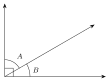
Two angles AA and BB that together make a right angle satisfy

A+B=90∘.A+B=90^\circ.

So if A=30∘A=30^\circ then 30∘+B=90∘30^\circ+B=90^\circ, and B=90∘−30∘=60∘B=90^\circ-30^\circ=60^\circ.

Complementary angles. A horizontal ray and a vertical ray meet at a right angle. A third ray between them splits the right angle into angle B, next to the horizontal ray, and angle A, next to the vertical ray.

A solution for an equation is a number that makes the statement true.

Example. For the equation x+3=7x+3=7, what value of xx makes the statement true? x+3=7→x=7−3→x=4x+3=7\to x=7-3\to x=4. The solution is 44.

Example. Is a=−2a=-2 the solution to the equation 7a+4=3a−27a+4=3a-2?

7(−2)+4=3(−2)−2→−14+4=−6−2→−10=−87(-2)+4=3(-2)-2\quad\to\quad-14+4=-6-2\quad\to\quad-10=-8

This is not true, so No, a=−2a=-2 is not a solution.

To remove a number that is being added in an equation, we must subtract it, and to keep the equation balanced it must be done to both sides. Note: subtracting a negative number is the same as adding the opposite.

Addition Property. If A=BA=B then A+C=B+CA+C=B+C.
If A+B=CA+B=C, to get BB to the other side:

A+B−B=C−B⇒A=C−BA+B-B=C-B\quad\Rightarrow\quad A=C-B

If A−B=CA-B=C:

A−B+B=C+B⇒A=C+BA-B+B=C+B\quad\Rightarrow\quad A=C+B

Example. Solve for xx.
a. x+4=−2a.\ x+4=-2: subtract 44 from both sides, x=−2−4=−6x=-2-4=-6. Check: −6+4=−2 ✓-6+4=-2\ \checkmark
b. 3x−2−2x=4−9b.\ 3x-2-2x=4-9: combine, (3x−2x)−2=−5(3x-2x)-2=-5, so x−2=−5x-2=-5 and x=−5+2=−3x=-5+2=-3.
Check: 3(−3)−2−2(−3)=−9−2+6=−5=4−9 ✓3(-3)-2-2(-3)=-9-2+6=-5=4-9\ \checkmark
c. x−34=58c.\ x-\dfrac34=\dfrac58: x=58+3⋅24⋅2=58+68=118x=\dfrac58+\dfrac{3\cdot2}{4\cdot2}=\dfrac58+\dfrac68=\dfrac{11}8.
Check: 118−34=118−68=58 ✓\dfrac{11}8-\dfrac34=\dfrac{11}8-\dfrac68=\dfrac58\ \checkmark

Angles

A right angle is 90∘90^\circ. A straight angle is 180∘180^\circ.

Example. Two angles make a right angle. One is 30∘30^\circ and the other is xx: 30∘+x=90∘30^\circ+x=90^\circ so x=60∘x=60^\circ.
Example. Two angles make a straight angle. One is 45∘45^\circ: 45∘+x=180∘45^\circ+x=180^\circ so x=135∘x=135^\circ.
Example. One angle is 57∘57^\circ on a straight line: x=180∘−57∘=123∘x=180^\circ-57^\circ=123^\circ.

Solving with Both Properties

Example. 4a+5=2a−74a+5=2a-7.

4a+5−5=2a−7−54a=2a−124a−2a=2a−12−2a2a=−12a=−6\begin{align*} 4a+5-5&=2a-7-5\\ 4a&=2a-12\\ 4a-2a&=2a-12-2a\\ 2a&=-12\\ a&=-6 \end{align*}

Check: 4(−6)+5=−24+5=−194(-6)+5=-24+5=-19 and 2(−6)−7=−12−7=−19 ✓2(-6)-7=-12-7=-19\ \checkmark

Example. 2(x−4)+5=−112(x-4)+5=-11.

2x−8+5=−11 → 2x−3=−11 → 2x=−8 → x=−42x-8+5=-11\ \to\ 2x-3=-11\ \to\ 2x=-8\ \to\ x=-4

Check: 2(−4−4)+5=2(−8)+5=−16+5=−11 ✓2(-4-4)+5=2(-8)+5=-16+5=-11\ \checkmark

Example. 5(2x−4)+3=4x−55(2x-4)+3=4x-5.

10x−20+3=4x−5 → 10x−17=4x−510x−4x=−5+17 → 6x=12 → x=2\begin{gather*}10x-20+3=4x-5\ \to\ 10x-17=4x-5\\ 10x-4x=-5+17\ \to\ 6x=12\ \to\ x=2\end{gather*}
Practice 4
Practice 5

The Multiplication Property of Equality

Multiplication Property. When C≠0C\neq0: if A=BA=B then AC=BCAC=BC.

Remember reciprocals: the number we multiply by to get 11. The reciprocal of ab\dfrac ab is ba\dfrac ba.

Example. Solve 12x=3\dfrac12x=3. Multiply both sides by 22:

2⋅12x=3⋅2 → 1x=6 → x=62\cdot\frac12x=3\cdot2\ \to\ 1x=6\ \to\ x=6

In general if A⋅1B=CA\cdot\dfrac1B=C then A⋅1B⋅B=C⋅BA\cdot\dfrac1B\cdot B=C\cdot B, so A=C⋅BA=C\cdot B. And if A⋅B=CA\cdot B=C then A⋅B⋅1B=C⋅1BA\cdot B\cdot\dfrac1B=C\cdot\dfrac1B, so A=CBA=\dfrac CB.

Example. 4x=−204x=-20:  4x⋅14=−20⋅14 → x=−54x\cdot\dfrac14=-20\cdot\dfrac14\ \to\ x=-5. Check: 4(−5)=−20 ✓4(-5)=-20\ \checkmark

Example. −3x+7=−5-3x+7=-5:

−3x=−5−7=−12 → −3x⋅1−3=−12⋅1−3 → x=4-3x=-5-7=-12\ \to\ -3x\cdot\frac1{-3}=-12\cdot\frac1{-3}\ \to\ x=4

Check: −3(4)+7=−12+7=−5 ✓-3(4)+7=-12+7=-5\ \checkmark

Example. 5x−8x+3=4−105x-8x+3=4-10:

(5x−8x)+3=4−10 → −3x+3=−6 → −3x=−9 → x=−9−3=3(5x-8x)+3=4-10\ \to\ -3x+3=-6\ \to\ -3x=-9\ \to\ x=\frac{-9}{-3}=3

Check: 5(3)−8(3)+3=15−24+3=−6=4−10 ✓5(3)-8(3)+3=15-24+3=-6=4-10\ \checkmark

Equations with Fractions

Example. 13x+2=7\dfrac13x+2=7.

13x=5 → x=5⋅3=15\frac13x=5\ \to\ x=5\cdot3=15

Check: 13(15)+2=5+2=7 ✓\dfrac13(15)+2=5+2=7\ \checkmark

Example. −45x=815-\dfrac45x=\dfrac8{15}. Multiply by the reciprocal −54-\dfrac54:

x=815(−54)=−2⋅4⋅53⋅5⋅4=−23x=\frac8{15}\left(-\frac54\right)=-\frac{2\cdot4\cdot5}{3\cdot5\cdot4}=-\frac23

Check: −45(−23)=815 ✓-\dfrac45\left(-\dfrac23\right)=\dfrac8{15}\ \checkmark

Example. 2x+12=342x+\dfrac12=\dfrac34.

2x=34−1⋅22⋅2=34−24=14 → x=14⋅12=182x=\frac34-\frac{1\cdot2}{2\cdot2}=\frac34-\frac24=\frac14\ \to\ x=\frac14\cdot\frac12=\frac18

Example. 3x+2=12\dfrac3x+2=\dfrac12.

3x=12−2⋅21⋅2=12−42=−32\frac3x=\frac12-\frac{2\cdot2}{1\cdot2}=\frac12-\frac42=-\frac32

If 3x=−32\dfrac3x=-\dfrac32, then taking reciprocals, x3=−23\dfrac x3=-\dfrac23, so x=−23⋅3=−2x=-\dfrac23\cdot3=-2.

Practice 6
Practice 7

Equations Containing Decimals

Example. x−3.5=8.7x-3.5=8.7: x=8.7+3.5=12.2x=8.7+3.5=12.2.

Example. 4y=−3.324y=-3.32: y=−3.324=−0.83y=\dfrac{-3.32}4=-0.83.

Example. 12x−2.59=3.81\dfrac12x-2.59=3.81.

12x=3.81+2.59=6.40 → x=2⋅6.40=12.8\frac12x=3.81+2.59=6.40\ \to\ x=2\cdot6.40=12.8

Example. 7a+0.61=−5a−0.897a+0.61=-5a-0.89.

7a+5a=−0.89−0.61 → 12a=−1.50 → a=−1.5012=−0.1257a+5a=-0.89-0.61\ \to\ 12a=-1.50\ \to\ a=\frac{-1.50}{12}=-0.125

(One way to see this: −150100⋅112=−32⋅112=−324=−18=−0.125-\dfrac{150}{100}\cdot\dfrac1{12}=-\dfrac32\cdot\dfrac1{12}=-\dfrac3{24}=-\dfrac18=-0.125.)

Example. 7a+0.61=5a−0.897a+0.61=5a-0.89.

2a=−0.89−0.61=−1.50 → a=−0.752a=-0.89-0.61=-1.50\ \to\ a=-0.75

Example. 1.18x+0.24=0.84x−0.781.18x+0.24=0.84x-0.78.

1.18x−0.84x=−0.78−0.24 → 0.34x=−1.02 → x=−1.020.34=−31.18x-0.84x=-0.78-0.24\ \to\ 0.34x=-1.02\ \to\ x=\frac{-1.02}{0.34}=-3
Practice 8

Applications

Example. The sum of a number and 22 is 88. Find the number.

x+2=8 → x=8−2=6x+2=8\ \to\ x=8-2=6

The sum of 66 and 22 is 88.

Example. If 55 is added to the sum of twice a number and three times the number the result is 2525. Find the number.

5+(2x+3x)=25 → 5+5x=25 → 5x=20 → x=45+(2x+3x)=25\ \to\ 5+5x=25\ \to\ 5x=20\ \to\ x=4

Check: 5+2(4)+3(4)=5+8+12=25 ✓5+2(4)+3(4)=5+8+12=25\ \checkmark

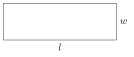
Example. The length of a rectangle is three times the width. The perimeter is 7272 cm. Find the width and length.

A rectangle with its length l marked along the bottom and its width w marked along the right side.
l=3wP=l+l+w+w=2l+2w=72l=3w\qquad P=l+l+w+w=2l+2w=72
2(3w)+2w=72 → 6w+2w=72 → 8w=72 → w=92(3w)+2w=72\ \to\ 6w+2w=72\ \to\ 8w=72\ \to\ w=9

So the width is 99 cm and the length is l=3⋅9=27l=3\cdot9=27 cm. Check: 27+27+9+9=72 ✓27+27+9+9=72\ \checkmark

Example. JoAnn is 2222 years older than her daughter Stacey. In six years the sum of their ages will be 4242. How old are they now?

Let JJ be JoAnn’s age and SS be Stacey’s age. J=22+SJ=22+S. In six years (J+6)+(S+6)=42(J+6)+(S+6)=42.

(22+S)+6+S+6=4234+2S=422S=8S=4\begin{align*} (22+S)+6+S+6&=42\\ 34+2S&=42\\ 2S&=8\\ S&=4 \end{align*}

Stacey is 44 and JoAnn is J=22+4=26J=22+4=26.

Example. A car rental company charges $11\$11 per day and 1616 cents per mile for their cars. If a car were rented for 11 day and the charge was $25.40\$25.40, how many miles was the car driven?

11⋅1+0.16m=25.40 → 0.16m=14.40 → m=14.400.16=9011\cdot1+0.16m=25.40\ \to\ 0.16m=14.40\ \to\ m=\frac{14.40}{0.16}=90

The car was driven 9090 miles.

Practice 9

Evaluating Formulas

F=95C+32F=\frac95C+32

is the conversion between Fahrenheit and Celsius. A formula is an equation that contains more than one variable. Here FF and CC are both variables.

Example. The perimeter of a rectangle is 2w+2l2w+2l. The perimeter of a livestock pen is 4040 ft. If the width is 66 ft, what is the length?

2(6)+2l=40 → 12+2l=40 → 2l=28 → l=282=14 ft2(6)+2l=40\ \to\ 12+2l=40\ \to\ 2l=28\ \to\ l=\frac{28}2=14\text{ ft}

Example. C=59(F−32)C=\dfrac59(F-32). Find CC when FF is 95∘95^\circ.

C=59(95−32)=59(63)=5⋅3⋅3⋅73⋅3=5⋅7=35C=\frac59(95-32)=\frac59(63)=\frac{5\cdot3\cdot3\cdot7}{3\cdot3}=5\cdot7=35

Example. y=2x+6y=2x+6. Find yy when x=−2x=-2: y=2(−2)+6=−4+6=2y=2(-2)+6=-4+6=2.

Example. 2x+3y=42x+3y=4. Find yy when x=3x=3.

2(3)+3y=4 → 6+3y=4 → 3y=−2 → y=−232(3)+3y=4\ \to\ 6+3y=4\ \to\ 3y=-2\ \to\ y=-\frac23
Practice 10

Worked-example videos