Foundations · Chapter 2
Arithmetic Review
The numbered examples below are interactive: the numbers change every time you load the page. Type your answer, press Enter or Check, and use New numbers to practice again.
Number Sets
In mathematics, a collection of numbers is called a set. For the beginning of this class we will only be concerned with two kinds of number sets.
Counting numbers (or natural numbers): positive numbers without fractions or decimals.
{1,2,3,…}
Whole numbers (counting numbers and 0):
{0,1,2,3,…}
Curly brackets { } are used in math to group together numbers in a set. An ellipsis … means “and so on”, meaning the numbers continue.
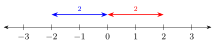
We can also denote a set with a number line: a straight line with equally spaced markings. Like the ellipsis, the arrow indicates the numbers continue.
Exponents
Sometimes we need to multiply a number, and sometimes we need to multiply the same number multiple times. Clever mathematicians have created a simple way to denote this, called exponents.
If we want to multiply the number 2 four times, instead of writing 2×2×2×2 we can simplify it to 24. The way we would read this out loud is “two to the fourth power”. In this case 4 is called the exponent and 2 is called the base.
Base — the number being multiplied.
Exponent — the number of times the base is being multiplied.
Written like: baseabexponent For the following examples, what is the base and what is the exponent? How would we say it?
a. 32b. 33c. 25
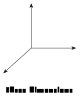
For the second and third powers there is another way we can say it. For something to the second power we can say it is “squared”. For something to the third power we can say it is “cubed”. These terms come from dimensionality: a square has two dimensions and a cube has three dimensions.
Now that we know what exponents are, let’s solve some.
Expand and solve.
a. 32b. 42c. 33d. 24
For example, 33=3⋅3⋅3=9⋅3=27 and 24=2⋅2⋅2⋅2=4⋅4=16. (Another way to check 3⋅3=9 is to add: 3+3+3=6+3=9.)
Special Cases
Let’s look at some special cases of exponents, specifically when the exponent is 0 or 1.
When the exponent is 1 the answer is equal to the base.
a1=afor example 21=2,71=7,24371=2437
When the exponent is 0 the answer is always 1.
a0=1for example 70=1,24370=1 Let’s do some examples.
a. 51b. 91c. 40d. 80
Order of Operations
Before we can specify an order, let’s discuss what we mean by operation.
An operation is something we do to a number or numbers. For example addition +, subtraction −, multiplication ⋅, division ÷, as well as grouping ( ) and [ ].
Does order really matter? Consider the expression 4+5⋅2. What answer do we get if we start with 4+5 and then multiply by 2? 4+5=9 and 9⋅2=18. Now what happens if we do 5⋅2 first and then add 4? 5⋅2=10 and 10+4=14. We have two different answers for the same expression depending on the order we solve the parts, so we can confidently say order matters.
In math there is a specific order that we solve the operations in an expression. We remember it as PEMDAS:
Parentheses ( ) [ ] (inner to outer)
Exponents ab
Multiplication / Division (moving from left to right)
Addition / Subtraction (moving from left to right)
Let’s look at our expression again, 4+5⋅2, and go down the list.
P? No parentheses. E? No exponents. M/D? Yes, 5⋅2=10, so the expression becomes 4+10. A/S? Yes, 4+10=14. So we know 14 is the correct answer.
Example. 4⋅8−2⋅6.
P? No. E? No. M/D? Yes, 4⋅8 and 2⋅6. We go from left to right, so we do 4⋅8=32 and then 2⋅6=12. Now we have 32−12. A/S? 32−12=20.
Example. 5+2⋅(7−1).
P? Yes, (7−1)=6→5+2⋅6. E? No. M/D? Yes, 2⋅6=12→5+12. A/S? 5+12=17.
Example. 3+2[10−3(5−2)].
P? Yes, [10−3(5−2)] and (5−2). Move from inner to outer, so (5−2)=3→[10−3(3)]→[10−9]→[1]→3+2[1]. E? No. M/D? 2[1]=2→3+2. A/S? 3+2=5.
More Practice
Example. 2+7⋅6+8(4−6)
=2+7⋅6+8(−2)=2+42+8(−2)=2+42+(−16)=44−16=28
Example. −23+5(3−9+24)
=−23+5(3−9+16)=−23+5(−6+16)=−23+5(10)=−8+5(10)=−8+50=42
Example. 7−24÷8×4+6
7−3×4+6=7−12+6=−5+6=1
Example. −1×[(3−4×7)÷5]−2×24÷6
=−1×[(3−28)÷5]−2×24÷6=−1×[(−25)÷5]−2×24÷6=−1×[−5]−2×24÷6=5−2×24÷6=5−48÷6=5−8=−3
Example. −4(102)+20÷(−4)
−4(100)+20÷(−4)=−400+(−5)=−400−5=−405
Example. (3×52÷15)−(5−22)
(3×25÷15)−(5−4)=(75÷15)−(1)=(5)−(1)=4
Example. 5(−12+7)⋅32
5(−5)⋅9=−25⋅9=−225
Example. 6(−3)(−2)=−18(−2)=36.
Example. 12−17−15+5(−4). Simplify the top and bottom separately:
12−17−15+(−20)=12−17−15−20=−5−35=7
Negative Numbers and Order Relations
Say you have $20 in a bank account and you draw $30 from it. How much money will you have in your bank account? −$10. When you subtract a larger number from a smaller number the result is negative.
Negative numbers are numbers below zero. They can be represented on a number line. The set of numbers {…,−3,−2,−1,0,1,2,3,…} is called the integers. Negative and positive numbers are inverses of each other.
A number to the left of another number is said to be less than. 1 is less than 2 (1<2). −5 is less than −3 (−5<−3). A number to the right of another is greater than. 3 is greater than 2 (3>2). −1 is greater than −2 (−1>−2).
So if a is greater than b we write a>b, and if a is less than b we write a<b. The further a negative number is from zero, the lesser it is.
Fill in the blank with < or >.
a. 27 _ 109b. 12 _ 7c. −7 _ 9d. −5 _ −14
Review. 7<12 (7 is less than 12), 21>5 (21 is greater than 5), and −5<−3 (−5 is less than −3).
Some Properties of Negative Numbers
Multiplying a negative and a positive number gives us a negative number: −a×b=−(ab). Multiplying two negative numbers gives us a positive number: −a×−b=ab. (More on these in the section on multiplication.)
Absolute Value
The absolute value of a number is its distance from zero on the number line. It is never negative. We write ∣a∣.
Inverse numbers have the same absolute value.
∣2∣=2∣−2∣=2
Find the absolute value.
a. ∣37∣b. ∣−56∣c. ∣−69∣d. ∣−48∣e. ∣9∣f. ∣12∣
Addition
For any two numbers a and b, the sum is a+b.
Properties of Addition
Commutative property. If a and b are any two numbers then
In other words, changing the order of two numbers in a sum doesn’t change the result.
Associative property. If a, b and c are any three numbers then
(a+b)+c=a+(b+c)
In other words, changing the grouping of three numbers doesn’t change the result.
Addition property of 0. If a is any number then
a+0=aand0+a=a
Adding 0 to any number leaves that number unchanged.
Rewrite each sum.
1. Using the commutative property:
a. 2+7b. 12+7c. 15+0d. 6+n
2. Using the associative property:
a. (12+15)+8b. (32+5)+1c. (13+4)+6d. (9+3)+7
Find each sum, using the properties to group numbers that are easy to add.
a. 3+5+7b. 2+8+6c. 5+6+7+8+9d. 9+3+2+7+1
Adding Positive and Negative Numbers
For the same sign, add the numbers and keep the sign:
a+b(−a)+(−b)=−(a+b)
For opposite signs, subtract the smaller from the larger and keep the sign of the larger:
−a+b=−(a−b) or b−aa+(−b)=a−b Adding a negative number is the same as subtracting the opposite.
a+(−b)=a−b
Subtracting a negative number is the same as adding the opposite.
a−(−b)=a+b
a−b=−(b−a)
Example. 10+(−5)+(−3)+4
10−5+(−3)+4=5+(−3)+4=5−3+4=2+4=6
Example. [−3+(−10)]+[8+(−2)]
[−3−10]+[8−2]=[−13]+[6]=−7
Review. 10+(−15)+7: 10−15+7=−5+7=7−5=2.
Find the sum of −12, −4, and 8: −12+(−4)+8=−12−4+8=−16+8=−8.
Find the sum of 9, 11, and −24: 9+11+(−24)=9+11−24=20−24=−4.
Application. It was 12∘F and the temperature drops by 14∘F. What temperature is it now? 12∘F−14∘F=−2∘F.
Subtraction
The difference of two numbers a and b is a−b. Subtraction is the same as adding the opposite:
a−b=a+(−b)
For any three numbers a, b, c: if a−b=c then b+c=a.
For example, if 8−3=5 then 3+5=8.
Multiplication
If we have any two numbers a and b and we multiply them, the result is called the product.
a⋅b=cc is the product
Properties of Multiplication
Commutative property. a⋅b=b⋅a. Changing the order does not change the product.
5⋅3=3⋅5→15=15
Associative property. a⋅(b⋅c)=(a⋅b)⋅c. Changing the grouping does not change the product.
(2⋅3)⋅6=2⋅(3⋅6)→6⋅6=2⋅18→36=36
Distributive property. a⋅(b+c)=a⋅b+a⋅c. Multiplication can be distributed over addition and subtraction.
2(3+4)=2⋅3+2⋅4→2(7)=6+8→14=14
Identity property. a×1=a, for example 9×1=9. Any number multiplied by 1 does not change the number.
Zero property. a×0=0, for example 5×0=0. Any number multiplied by zero is zero.
Examples.
Associative property: (2×7)×9=14×9=126, and 2×(7×9)=2×63=126. Also 2×(21×3)=2×63=126 and (2×21)×3=42×3=126.
Commutative property: 4×3=12=3×4; 9×2=18=2×9; −3×12=−36=12×(−3); 5×7=35=7×5.
Distributive property: 3(7+4)=21+12=33 and 3(11)=33; 9(3+2)=27+18=45 and 9(5)=45.
Identity property: 9×1=9; 7×1=7; −5×1=−5.
Zero property: 11×0=0; 32×0=0; −72×0=0.
Multiplication with Negative Numbers
a⋅(−b)=−(ab)−a⋅b=−(ab)(−a)⋅(−b)=ab
If both numbers have the same sign the result is positive. If they have opposite signs the result is negative.
Why? Multiplication is repeated addition. 3⋅5=5+5+5=15 and
3⋅(−5)=(−5)+(−5)+(−5)=−5−5−5=−15
and −3⋅(−5)=−(−5)−(−5)−(−5)=+5+5+5=15.
Example. a. 2(4)b. −2(−4)c. 2(−4)d. −2(4)
a. 2(4)b. −2(−4)c. 2(−4)d. −2(4)=4+4=8=−(−2)−(−2)−(−2)−(−2)=2+2+2+2=8=−(2)−(2)−(2)−(2)=−4−4=−8=(−2)+(−2)+(−2)+(−2)=−2−2−2−2=−8
Example. Simplify.
a. −4(3)(−5)b. −3(2)(−1)c. −4+5(−6+2)d. −3(2−9)+4(−7−2)=−12(−5)=60=−6(−1)=6=−4+5(−4)=−4+(−20)=−4−20=−24=−3(−7)+4(−9)=21+(−36)=21−36=−15
Division
Properties of Division
In ba=c, a is the dividend, b is the divisor and c is the quotient.
Dividing by 1 leaves a number unchanged: a÷1=a.
Multiplying the top and bottom by the same number gives an equivalent fraction (for n=0):
ba=nbnafor example12=24=48 Division with Negative Numbers
For a and b, if a÷b=c then b⋅c=a. This is how we know the sign rules:
6÷36÷(−3)−6÷3−6÷(−3)=2=−2=−2=2because 3⋅2because −3⋅(−2)because 3⋅(−2)because −3⋅2=6=6=−6=−6
For numbers a and b where b is not equal to zero:
−a÷b=−(a÷b)a÷(−b)=−(a÷b)−a÷(−b)=a÷b
b−a=−ba=−(ba)−b−a=ba Divide.
a. 12÷4b. −12÷4c. 12÷(−4)d. −12÷(−4)
a. 520b. 5−20c. −520d. −5−20
Long Division Practice
Divide using long division, then check your answer by multiplying.
a. 6750÷5b. 50,400÷3c. 1440÷32
d. 227,920÷56e. 9380÷35f. 23,072÷32
More long division.
a. 465÷5b. 595÷7c. 384÷12d. 294÷14
Simplifying Algebraic Expressions
The Associative Property
4(5x)=(4⋅5)x=20x
Associative property: (a+b)+c=a+(b+c) and (a⋅b)⋅c=a⋅(b⋅c).
Examples.
a. −2(5x)b. 3(−4y)c. (2x+5)+10=(−2⋅5)x=−10x=(3⋅(−4))y=−12y=2x+(5+10)=2x+15
The Distributive Property
a(b+c)=ab+ac
Examples.
a. 2(a−3)b. 4(5x+3)c. 5(2x+3y)=2a−(2⋅3)=2a−6=(4⋅5x)+(4⋅3)=20x+12=(5⋅2x)+(5⋅3y)=10x+15y
Similar Terms
Similar terms have the same variable, for example 4x and 3x. We combine them by adding the numbers in front.
a. 4x+3xb. 7a+ac. −5x+7xd. 8y−ye. −4a−2af. 3x−7x=(4+3)x=7x=(7+1)a=8a=(−5+7)x=2x=(8−1)y=7y=(−4−2)a=−6a=(3−7)x=−4x
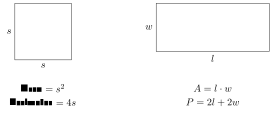
Area and Perimeter
Summary
I. Number sets. Counting numbers {1,2,3,…} and whole numbers {0,1,2,3,…}.
II. Order of operations. To simplify a mathematical expression:
Begin with expressions inside parentheses ( ) [ ].
Evaluate exponents.
Multiplication and division from left to right.
Addition and subtraction from left to right.
III. Exponents. The base is the number being multiplied and the exponent is the number of times it is being multiplied. a0=1 and a1=a.
IV. Absolute value. The distance from 0 on the number line. It is never negative.
V. Addition and multiplication.
Commutative property: of addition a+b=b+a, of multiplication a⋅b=b⋅a.
Associative property: of addition (a+b)+c=a+(b+c), of multiplication (a⋅b)⋅c=a⋅(b⋅c).
Distributive property: a(b+c)=ab+ac.
VI. Addition of positive and negative numbers. For the same sign, add them: a+b and (−a)+(−b)=−(a+b). For opposite signs, subtract: −a+b=−(a−b) and a+(−b)=a−b.
VII. Subtraction. a−b=a+(−b).
The following extra problems come from the typed notes on exponents and negative numbers.
For the following problems, identify the base, the exponent, and how it is said.
a. 35b. 57c. 42d. 93
For the following problems, solve the expressions.
a. 211b. 121c. 230d. 70
For the following problems choose the correct symbol > or <.
a. 3 _ 5b. −5 _ −7c. 4 _ 2d. −9 _ 3