MAT040 Beginning Algebra All classes

Foundations · Chapter 4

Fractions

The numbered examples below are interactive: the numbers change every time you load the page. Type your answer, press Enter or Check, and use New numbers to practice again.

The Meaning and Properties of Fractions

A fraction is written

ab← numerator← denominator\frac{a}{b}\quad\begin{matrix}\leftarrow\text{ numerator}\\[-2pt]\leftarrow\text{ denominator}\end{matrix}

The denominator tells us how many equal parts the whole has been broken into.
The numerator tells us how many of those parts we are talking about.

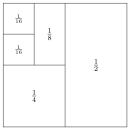
A whole can be broken into many differently sized pieces. In Figure 1 one square is broken into pieces of size 12\frac12, 14\frac14, 18\frac18 and 116\frac1{16}.

A square cut into fractions. The right half is labeled 1/2. The left half is cut into a lower-left quarter labeled 1/4 and an upper part. The upper part is cut into a piece labeled 1/8 and a left strip split into two pieces each labeled 1/16.
Figure 1. Pieces of a whole

To visualize 34\frac34 we break a box into four equal pieces and shade three of them. To visualize 59\frac59 we break a circle into nine equal slices and shade five.

34\dfrac34 Rectangle made of 4 equal squares in 2 rows and 2 columns. 3 of the squares are shaded.     59\dfrac59 Circle cut into 9 equal slices. 5 of the slices are shaded.

Example 1

Name the numerator and denominator.

a. 34a.\ \dfrac34   b. 512b.\ \dfrac5{12}   c. a11c.\ \dfrac a{11}   d. 91d.\ \dfrac91

a.a. Numerator 33, denominator 44.  b.b. Numerator 55, denominator 1212.  c.c. Numerator aa, denominator 1111.  d.d. Numerator 99, denominator 11.

Proper and Improper Fractions

A fraction ab\dfrac ab is a proper fraction if a<ba<b. For example 34, 18, a10\dfrac34,\ \dfrac18,\ \dfrac a{10} (when a<10a<10).
A fraction ab\dfrac ab is an improper fraction if a≥ba\geq b. For example 95, 1010, 61\dfrac95,\ \dfrac{10}{10},\ \dfrac61.

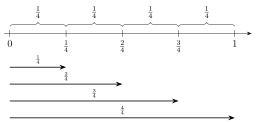
Fractions can be shown on a number line. Here the space from 00 to 11 is broken into four equal pieces of size 14\frac14. Each arrow starts at 00 and shows 14\frac14, 24\frac24, 34\frac34 and 44\frac44.

Number line from 0 to 1 marked at 0, 1/4, 2/4, 3/4 and 1, with a brace over each fourth. Below it, four arrows start at 0 and reach 1/4, 2/4, 3/4 and 4/4, each one longer than the last.

Equivalent Fractions

Look at the two squares below. Both have the same amount shaded, even though they are broken into different numbers of pieces.

24\dfrac24 Rectangle made of 4 equal squares in 2 rows and 2 columns. 2 of the squares are shaded.     =    \;\;=\;\; 12\dfrac12 Rectangle made of 2 equal squares in 1 row and 2 columns. 1 of the squares is shaded.

The same is true for circles. 26\frac26 and 13\frac13 shade the same amount, and so does 412\frac4{12}:

26\dfrac26 Circle cut into 6 equal slices. 2 of the slices are shaded.   13\dfrac13 Circle cut into 3 equal slices. 1 of the slices is shaded.   412\dfrac4{12} Circle cut into 12 equal slices. 4 of the slices are shaded.

13=26=412\frac13=\frac26=\frac4{12}

Fractions that name the same amount are called equivalent fractions.

We can create an equivalent fraction by multiplying the numerator and denominator by the same non-zero number nn:

ab=a⋅nb⋅n\frac ab=\frac{a\cdot n}{b\cdot n}

We can also create an equivalent fraction by dividing the numerator and denominator by the same non-zero number nn:

ab=a÷nb÷n\frac ab=\frac{a\div n}{b\div n}

For example

34=3⋅54⋅5=1520and34=3⋅3x4⋅3x=9x12xand1012=10÷212÷2=56.\frac34=\frac{3\cdot5}{4\cdot5}=\frac{15}{20} \qquad\text{and}\qquad \frac34=\frac{3\cdot3x}{4\cdot3x}=\frac{9x}{12x} \qquad\text{and}\qquad \frac{10}{12}=\frac{10\div2}{12\div2}=\frac56.

Two more facts we will use often: any number divided by 11 is itself, and any (non-zero) number divided by itself is 11.

a1=aaa=1(a≠0)\frac a1=a\qquad\qquad \frac aa=1\quad(a\neq0)
Example 2

Write each fraction as a whole number.

a. 91a.\ \dfrac91   b. 99b.\ \dfrac99   c. 189c.\ \dfrac{18}9   d. 279d.\ \dfrac{27}9

a. 91=9b. 99=1c. 189=2d. 279=3a.\ \dfrac91=9\qquad b.\ \dfrac99=1\qquad c.\ \dfrac{18}9=2\qquad d.\ \dfrac{27}9=3

Example 3

Which of 58, 56, 34, 23\dfrac58,\ \dfrac56,\ \dfrac34,\ \dfrac23 is the smallest? Write all four with a denominator of 2424 and then order them from smallest to largest.

Since 8⋅3=248\cdot3=24, 6⋅4=246\cdot4=24, 4⋅6=244\cdot6=24, 3⋅8=243\cdot8=24:

5⋅38⋅3=1524,5⋅46⋅4=2024,3⋅64⋅6=1824,2⋅83⋅8=1624\frac{5\cdot3}{8\cdot3}=\frac{15}{24},\quad \frac{5\cdot4}{6\cdot4}=\frac{20}{24},\quad \frac{3\cdot6}{4\cdot6}=\frac{18}{24},\quad \frac{2\cdot8}{3\cdot8}=\frac{16}{24}
1524<1624<1824<2024⟹58<23<34<56\frac{15}{24}<\frac{16}{24}<\frac{18}{24}<\frac{20}{24}\qquad\Longrightarrow\qquad\frac58<\frac23<\frac34<\frac56

The smallest is 58\dfrac58.

Prime Numbers

A prime number is a whole number greater than 11 that has exactly two divisors: itself and 11. In other words, we cannot divide a prime by any other number and get a whole number back (without a remainder).
Prime numbers: {2,3,5,7,11,…}\{2,3,5,7,11,\ldots\}

A composite number is a whole number greater than 11 that is not a prime number. That is, there exists a number other than itself and 11 that we can divide a composite number by and get a whole number.

Example 4

Identify each number as prime or composite.

a. 17a.\ 17     b. 12b.\ 12

a.a. 1717 is not divisible by 2,3,5,7,112,3,5,7,11 or 1313 (each leaves a remainder), so 1717 is prime.
b.b. 122=6\dfrac{12}2=6 is a whole number, so 1212 is divisible by something other than itself and 11. 1212 is composite.

Prime Factorization

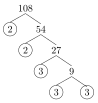
Every composite number can be broken into prime numbers. One way to do this is with a factor tree: split the number into two factors and keep splitting any factor that is not prime. We circle the primes. Reading all of the circled primes gives the prime factorization.

For 1212:

Factor tree for 12: 12 splits into 2 and 6, 6 splits into 2 and 3.    12=2⋅2⋅3=22⋅312=2\cdot2\cdot3=2^2\cdot3

For 108108:

Factor tree for 108: 108 splits into 2 and 54, 54 splits into 2 and 27, 27 splits into 3 and 9, 9 splits into 3 and 3.   

108=2⋅2⋅3⋅3⋅3=22⋅33\begin{aligned}108&=2\cdot2\cdot3\cdot3\cdot3\\&=2^2\cdot3^3\end{aligned}

Example 5

Find the prime factorization of each number. Write your answer with exponents.

a. 60a.\ 60   b. 352b.\ 352   c. 125c.\ 125

a.a. 60=2⋅30=2⋅3⋅10=2⋅3⋅2⋅560=2\cdot30=2\cdot3\cdot10=2\cdot3\cdot2\cdot5, so 60=22⋅3⋅560=2^2\cdot3\cdot5.
 Factor tree for 60: 60 splits into 2 and 30, 30 splits into 3 and 10, 10 splits into 2 and 5.
b.b. 352=2⋅176=2⋅2⋅88=2⋅2⋅2⋅44=2⋅2⋅2⋅2⋅22=2⋅2⋅2⋅2⋅2⋅11352=2\cdot176=2\cdot2\cdot88=2\cdot2\cdot2\cdot44=2\cdot2\cdot2\cdot2\cdot22=2\cdot2\cdot2\cdot2\cdot2\cdot11, so 352=25⋅11352=2^5\cdot11.
c.c. 125=5⋅25=5⋅5⋅5125=5\cdot25=5\cdot5\cdot5, so 125=53125=5^3.

Instead of a factor tree we can divide by primes over and over until we reach 11 (or a prime). For instance 352÷2=176352\div2=176, 176÷2=88176\div2=88, and so on.

Lowest Terms

A fraction is in lowest terms when its numerator and denominator have no factors in common (other than 11).

If we divide the numerator and denominator by 22,

68=6÷28÷2=34\frac68=\frac{6\div2}{8\div2}=\frac34

and 34\frac34 is the lowest term of 68\frac68.

Prime factorizations make it easy to find common factors. For 1215\frac{12}{15} we have 12=2⋅2⋅312=2\cdot2\cdot3 and 15=3⋅515=3\cdot5, so

1215=2⋅2⋅33⋅5=45.\frac{12}{15}=\frac{2\cdot2\cdot\cancel{3}}{\cancel{3}\cdot5}=\frac45.
Example 6

Reduce each fraction to lowest terms.

a. 2024a.\ \dfrac{20}{24}   b. 642b.\ \dfrac6{42}   c. 440c.\ \dfrac4{40}   d. −10530d.\ -\dfrac{105}{30}   e. 13624e.\ \dfrac{136}{24}

a. 2024=2⋅2⋅52⋅2⋅2⋅3=52⋅3=56b. 642=2⋅32⋅3⋅7=17c. 440=2⋅22⋅2⋅2⋅5=12⋅5=110d. −10530=−3⋅5⋅72⋅3⋅5=−72e. 13624=2⋅2⋅2⋅172⋅2⋅2⋅3=173\begin{align*} a.\ \frac{20}{24}&=\frac{2\cdot2\cdot5}{2\cdot2\cdot2\cdot3}=\frac5{2\cdot3}=\frac56\\ b.\ \frac6{42}&=\frac{2\cdot3}{2\cdot3\cdot7}=\frac17\\ c.\ \frac4{40}&=\frac{2\cdot2}{2\cdot2\cdot2\cdot5}=\frac1{2\cdot5}=\frac1{10}\\ d.\ -\frac{105}{30}&=-\frac{3\cdot5\cdot7}{2\cdot3\cdot5}=-\frac72\\ e.\ \frac{136}{24}&=\frac{2\cdot2\cdot2\cdot17}{2\cdot2\cdot2\cdot3}=\frac{17}3 \end{align*}

Multiplication with Fractions

Rule. The product of two fractions is a fraction whose numerator is the product of the two numerators and whose denominator is the product of the two denominators.

ab⋅cd=a⋅cb⋅d\frac ab\cdot\frac cd=\frac{a\cdot c}{b\cdot d}

Example.

35⋅27=3⋅25⋅7=635\frac35\cdot\frac27=\frac{3\cdot2}{5\cdot7}=\frac6{35}

Remember 5=515=\dfrac51, so a whole number can be multiplied with a fraction too.

38⋅5=38⋅51=3⋅58⋅1=158\frac38\cdot5=\frac38\cdot\frac51=\frac{3\cdot5}{8\cdot1}=\frac{15}8

Parentheses first:

12(34⋅15)=12(320)=1⋅32⋅20=340\frac12\left(\frac34\cdot\frac15\right)=\frac12\left(\frac3{20}\right)=\frac{1\cdot3}{2\cdot20}=\frac3{40}

When the numbers are larger, factor and cancel before multiplying.

158⋅49=3⋅52⋅2⋅2⋅2⋅23⋅3=3⋅5⋅2⋅22⋅2⋅2⋅3⋅3=52⋅3=56\frac{15}8\cdot\frac49=\frac{3\cdot5}{2\cdot2\cdot2}\cdot\frac{2\cdot2}{3\cdot3} =\frac{\cancel3\cdot5\cdot\cancel2\cdot\cancel2}{\cancel2\cdot\cancel2\cdot2\cdot\cancel3\cdot3}=\frac5{2\cdot3}=\frac56

With negative numbers the same sign rules apply (see Negative Numbers).

−92⋅818=−3⋅32⋅2⋅2⋅22⋅3⋅3=−21=−2(−34)2=(−34)(−34)=916-\frac92\cdot\frac8{18}=-\frac{3\cdot3}{2}\cdot\frac{2\cdot2\cdot2}{2\cdot3\cdot3}=-\frac21=-2 \qquad \left(-\frac34\right)^2=\left(-\frac34\right)\left(-\frac34\right)=\frac9{16}

“Of” means multiply

34 of 12=34⋅121=3⋅2⋅2⋅32⋅2⋅1=91=9\frac34\text{ of }12=\frac34\cdot\frac{12}1=\frac{3\cdot2\cdot2\cdot3}{2\cdot2\cdot1}=\frac91=9
25 of 35=25⋅351=2⋅7⋅55⋅1=141=14\frac25\text{ of }35=\frac25\cdot\frac{35}1=\frac{2\cdot7\cdot5}{5\cdot1}=\frac{14}1=14

The Area of a Triangle

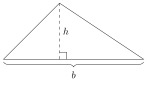
Let bb be the base and hh the height of a triangle. Its area is

A=12bh.A=\frac12bh.
A triangle with base b along the bottom and a dashed vertical height h from the top corner down to the base, meeting it at a right angle.

Example. A triangle has a base of 1010 in and a height of 77 in.

A=12(7 in)(10 in)=12⋅7⋅2⋅5=1⋅7⋅5=35 in2A=\frac12(7\text{ in})(10\text{ in})=\frac12\cdot7\cdot2\cdot5=1\cdot7\cdot5=35\text{ in}^2

Example. A triangle has a base of 66 in and a height of 55 in.

A=12⋅5⋅6=12⋅30=302=15 in2A=\frac12\cdot5\cdot6=\frac12\cdot30=\frac{30}2=15\text{ in}^2

Division with Fractions

Reciprocals

Two numbers whose product is 11 are said to be reciprocals. The reciprocal of ab\dfrac ab is ba\dfrac ba (for a≠0a\neq0, b≠0b\neq0).

ab⋅ba=a⋅bb⋅a=a⋅ba⋅b=1\frac ab\cdot\frac ba=\frac{a\cdot b}{b\cdot a}=\frac{a\cdot b}{a\cdot b}=1
5⋅15=51⋅15=5⋅11⋅5=134⋅43=1212=178⋅87=5656=15\cdot\frac15=\frac51\cdot\frac15=\frac{5\cdot1}{1\cdot5}=1\qquad \frac34\cdot\frac43=\frac{12}{12}=1\qquad \frac78\cdot\frac87=\frac{56}{56}=1

Dividing Fractions

To divide by a fraction, multiply by its reciprocal.

ab÷cd=ab⋅dc\frac ab\div\frac cd=\frac ab\cdot\frac dc
12÷14=12⋅41=1⋅2⋅22⋅1=21=2\frac12\div\frac14=\frac12\cdot\frac41=\frac{1\cdot\cancel2\cdot2}{\cancel2\cdot1}=\frac21=2
38÷94=38⋅49=3⋅2⋅22⋅2⋅2⋅3⋅3=12⋅3=16\frac38\div\frac94=\frac38\cdot\frac49=\frac{\cancel3\cdot\cancel2\cdot\cancel2}{\cancel2\cdot\cancel2\cdot2\cdot\cancel3\cdot3}=\frac1{2\cdot3}=\frac16
23÷2=23⋅12=2⋅13⋅2=132÷(−13)=21⋅(−31)=2⋅(−3)1⋅1=−6\frac23\div2=\frac23\cdot\frac12=\frac{\cancel2\cdot1}{3\cdot\cancel2}=\frac13 \qquad 2\div\left(-\frac13\right)=\frac21\cdot\left(-\frac31\right)=\frac{2\cdot(-3)}{1\cdot1}=-6
−427÷169=−427⋅916=−2⋅2⋅3⋅33⋅3⋅3⋅2⋅2⋅2⋅2=−13⋅2⋅2=−112-\frac4{27}\div\frac{16}9=-\frac4{27}\cdot\frac9{16}=-\frac{2\cdot2\cdot3\cdot3}{3\cdot3\cdot3\cdot2\cdot2\cdot2\cdot2}=-\frac1{3\cdot2\cdot2}=-\frac1{12}
Example 7

Divide.

a. 1635÷8a.\ \dfrac{16}{35}\div8     b. 27÷32b.\ 27\div\dfrac32     c. 932÷278c.\ \dfrac9{32}\div\dfrac{27}8

a. 1635⋅18=2⋅2⋅2⋅2⋅15⋅7⋅2⋅2⋅2=235a.\ \dfrac{16}{35}\cdot\dfrac18=\dfrac{2\cdot2\cdot2\cdot2\cdot1}{5\cdot7\cdot2\cdot2\cdot2}=\dfrac2{35}
b. 271⋅23=3⋅3⋅3⋅21⋅3=3⋅3⋅2=18b.\ \dfrac{27}1\cdot\dfrac23=\dfrac{3\cdot3\cdot3\cdot2}{1\cdot3}=3\cdot3\cdot2=18
c. 932⋅827=3⋅32⋅2⋅2⋅2⋅2⋅2⋅2⋅23⋅3⋅3=12⋅2⋅13=112c.\ \dfrac9{32}\cdot\dfrac8{27}=\dfrac{3\cdot3}{2\cdot2\cdot2\cdot2\cdot2}\cdot\dfrac{2\cdot2\cdot2}{3\cdot3\cdot3}=\dfrac1{2\cdot2}\cdot\dfrac13=\dfrac1{12}

Order of Operations with Fractions

The order of operations (see Order of Operations) works exactly the same with fractions.

Example. 83÷16+5\displaystyle\frac83\div\frac16+5

83÷16+5=83⋅61+5=2⋅2⋅2⋅2⋅33⋅1+5=161+5=16+5=21\frac83\div\frac16+5=\frac83\cdot\frac61+5=\frac{2\cdot2\cdot2\cdot2\cdot\cancel3}{\cancel3\cdot1}+5=\frac{16}1+5=16+5=21

Example. [32÷(43)2]+[75÷(52)2]\displaystyle\left[32\div\left(\frac43\right)^2\right]+\left[75\div\left(\frac52\right)^2\right]

Exponents first, then divide inside each bracket, then add.

=[32÷169]+[75÷254]=[32⋅916]+[75⋅425]=[2⋅9]+[3⋅4]=18+12=30\begin{align*} &=\left[32\div\frac{16}9\right]+\left[75\div\frac{25}4\right]\\ &=\left[32\cdot\frac9{16}\right]+\left[75\cdot\frac4{25}\right]\\ &=\left[2\cdot9\right]+\left[3\cdot4\right]=18+12=30 \end{align*}

Addition and Subtraction with Fractions

Remember the distributive property:

a(b+c)=a(b)+a(c)a(b+c)=a(b)+a(c)

When we add fractions with the same denominator, we can factor out 17\frac17:

27+37=2(17)+3(17)=17(2+3)=17(5)=51⋅17=57\frac27+\frac37=2\left(\frac17\right)+3\left(\frac17\right)=\frac17(2+3)=\frac17(5)=\frac51\cdot\frac17=\frac57

Note that a⋅1b=a1⋅1b=aba\cdot\dfrac1b=\dfrac a1\cdot\dfrac1b=\dfrac ab.

Rule. To add two fractions that have the same denominator, we add their numerators to get the numerator of the answer. The denominator is the same as the original fractions.

ac+bc=a+bc\frac ac+\frac bc=\frac{a+b}c

It is the same for subtraction.

ac−bc=a−bc\frac ac-\frac bc=\frac{a-b}c

Examples.

38+18=3+18=48=1295−35=9−35=6537+27+97=3+2+97=147=2\frac38+\frac18=\frac{3+1}8=\frac48=\frac12\qquad \frac95-\frac35=\frac{9-3}5=\frac65\qquad \frac37+\frac27+\frac97=\frac{3+2+9}7=\frac{14}7=2

The Least Common Denominator

The Least Common Denominator (LCD) for a set of denominators is the smallest number that is exactly divisible by each denominator.

Example. Find the LCD for 512\dfrac5{12} and 718\dfrac7{18}.

Factor each denominator: 12=2⋅2⋅312=2\cdot2\cdot3 and 18=2⋅3⋅318=2\cdot3\cdot3. The LCD uses each prime as many times as it appears in the denominator where it appears most:

LCD=2⋅2⋅3⋅3=4⋅9=36\text{LCD}=2\cdot2\cdot3\cdot3=4\cdot9=36

Notice 36=12⋅336=12\cdot3 and 36=18⋅236=18\cdot2. So

512=5⋅312⋅3=1536718=7⋅218⋅2=1436\frac5{12}=\frac{5\cdot3}{12\cdot3}=\frac{15}{36}\qquad\frac7{18}=\frac{7\cdot2}{18\cdot2}=\frac{14}{36}
512+718=1536+1436=15+1436=2936\frac5{12}+\frac7{18}=\frac{15}{36}+\frac{14}{36}=\frac{15+14}{36}=\frac{29}{36}

To add or subtract fractions with different denominators:
Step 1. Factor the denominators.
Step 2. Rewrite each fraction as an equivalent fraction with the LCD as its denominator.
Step 3. Add or subtract the numerators of the equivalent fractions.
Step 4. Reduce the fraction.

Example. 34+16\dfrac34+\dfrac16. Here 4=2⋅24=2\cdot2 and 6=2⋅36=2\cdot3, so LCD=2⋅2⋅3=12\text{LCD}=2\cdot2\cdot3=12.

34+16=3⋅34⋅3+1⋅26⋅2=912+212=1112\frac34+\frac16=\frac{3\cdot3}{4\cdot3}+\frac{1\cdot2}{6\cdot2}=\frac9{12}+\frac2{12}=\frac{11}{12}

Example. 715−310\dfrac7{15}-\dfrac3{10}. Here 15=3⋅515=3\cdot5 and 10=2⋅510=2\cdot5, so LCD=3⋅5⋅2=30\text{LCD}=3\cdot5\cdot2=30.

715−310=1430−930=14−930=530=16\frac7{15}-\frac3{10}=\frac{14}{30}-\frac9{30}=\frac{14-9}{30}=\frac5{30}=\frac16

Example. 35−16\dfrac35-\dfrac16. The LCD is 5⋅6=305\cdot6=30.

35−16=3⋅65⋅6−1⋅56⋅5=1830−530=1330\frac35-\frac16=\frac{3\cdot6}{5\cdot6}-\frac{1\cdot5}{6\cdot5}=\frac{18}{30}-\frac5{30}=\frac{13}{30}

Example. 16+18+14\dfrac16+\dfrac18+\dfrac14. Here 6=2⋅36=2\cdot3, 8=2⋅2⋅28=2\cdot2\cdot2, 4=2⋅24=2\cdot2, so LCD=3⋅2⋅2⋅2=24\text{LCD}=3\cdot2\cdot2\cdot2=24.

424+324+624=4+3+624=1324\frac4{24}+\frac3{24}+\frac6{24}=\frac{4+3+6}{24}=\frac{13}{24}

Example. A whole number is a fraction over 11: 3−56=31−56=186−56=1363-\dfrac56=\dfrac31-\dfrac56=\dfrac{18}6-\dfrac56=\dfrac{13}6.

With Negative Fractions

38+(−18)=3+(−1)8=3−18=28=14\frac38+\left(-\frac18\right)=\frac{3+(-1)}8=\frac{3-1}8=\frac28=\frac14
110+(−45)+(−320)=220+(−1620)+(−320)=2−16−320=−1720=−1720\frac1{10}+\left(-\frac45\right)+\left(-\frac3{20}\right) =\frac2{20}+\left(-\frac{16}{20}\right)+\left(-\frac3{20}\right) =\frac{2-16-3}{20}=\frac{-17}{20}=-\frac{17}{20}
−35−25=−3−25=−55=−1-\frac35-\frac25=\frac{-3-2}5=\frac{-5}5=-1
Example 8

Find the LCD and write the fractions from smallest to largest.

58,516,34,12\dfrac58,\quad\dfrac5{16},\quad\dfrac34,\quad\dfrac12

8=2⋅2⋅28=2\cdot2\cdot2, 16=2⋅2⋅2⋅216=2\cdot2\cdot2\cdot2, 4=2⋅24=2\cdot2, 2=22=2, so LCD=16\text{LCD}=16.

58=1016,516,34=1216,12=816\frac58=\frac{10}{16},\quad\frac5{16},\quad\frac34=\frac{12}{16},\quad\frac12=\frac8{16}
516<816<1016<1216⟹516<12<58<34\frac5{16}<\frac8{16}<\frac{10}{16}<\frac{12}{16}\qquad\Longrightarrow\qquad\frac5{16}<\frac12<\frac58<\frac34

Review Problems

Review Problems
  1. Factor 4848 into its prime numbers.

  2. Reduce 4560\dfrac{45}{60} to lowest terms.

  3. Multiply 158⋅49\dfrac{15}8\cdot\dfrac49.

  4. Find the quotient of (−2)(-2) and (−13)\left(-\dfrac13\right).

  5. Simplify 4844÷(−411)2\dfrac{48}{44}\div\left(-\dfrac4{11}\right)^2 as much as possible.

  6. Simplify 78−1214+12\dfrac{\dfrac78-\dfrac12}{\dfrac14+\dfrac12}.

  7. Subtract 56\dfrac56 from the product of 32\dfrac32 and 23\dfrac23.

  8. If the quotient of 1818 and 35\dfrac35 is increased by 1010, what number results?

  9. 68−28\dfrac68-\dfrac28

  10. −715+512-\dfrac7{15}+\dfrac5{12}

  11. Find the prime factorization of 2244022440.

  12. Simplify ([(52)3÷52]−[(32)2÷458])÷11710\left(\left[\left(\dfrac52\right)^3\div\dfrac52\right]-\left[\left(\dfrac32\right)^2\div\dfrac{45}8\right]\right)\div\dfrac{117}{10}

Also reduce: 210270\dfrac{210}{270} and 125370\dfrac{125}{370}.

  1. 48=2⋅2⋅2⋅2⋅3=24⋅348=2\cdot2\cdot2\cdot2\cdot3=2^4\cdot3

  2. 4560=3⋅3⋅52⋅2⋅3⋅5=34\dfrac{45}{60}=\dfrac{3\cdot3\cdot5}{2\cdot2\cdot3\cdot5}=\dfrac34

  3. 158⋅49=56\dfrac{15}8\cdot\dfrac49=\dfrac56 (see the multiplication section)

  4. −2÷(−13)=−21⋅−31=61=6-2\div\left(-\dfrac13\right)=\dfrac{-2}1\cdot\dfrac{-3}1=\dfrac61=6

  5. (−411)2=16121\left(-\dfrac4{11}\right)^2=\dfrac{16}{121}, so 4844⋅12116=2⋅2⋅2⋅2⋅32⋅2⋅11⋅11⋅112⋅2⋅2⋅2=3⋅112⋅2=334\dfrac{48}{44}\cdot\dfrac{121}{16}=\dfrac{2\cdot2\cdot2\cdot2\cdot3}{2\cdot2\cdot11}\cdot\dfrac{11\cdot11}{2\cdot2\cdot2\cdot2}=\dfrac{3\cdot11}{2\cdot2}=\dfrac{33}4

  6. Numerator: 78−48=38\dfrac78-\dfrac48=\dfrac38. Denominator: 14+24=34\dfrac14+\dfrac24=\dfrac34. Then 38÷34=38⋅43=12\dfrac38\div\dfrac34=\dfrac38\cdot\dfrac43=\dfrac12.

  7. 32⋅23−56=1−56=66−56=16\dfrac32\cdot\dfrac23-\dfrac56=1-\dfrac56=\dfrac66-\dfrac56=\dfrac16

  8. (18÷35)+10=181⋅53+10=30+10=40\left(18\div\dfrac35\right)+10=\dfrac{18}1\cdot\dfrac53+10=30+10=40

  9. 68−28=48=2⋅22⋅2⋅2=12\dfrac68-\dfrac28=\dfrac48=\dfrac{2\cdot2}{2\cdot2\cdot2}=\dfrac12

  10. LCD=5⋅3⋅2⋅2=60\text{LCD}=5\cdot3\cdot2\cdot2=60: −2860+2560=−360=−120-\dfrac{28}{60}+\dfrac{25}{60}=\dfrac{-3}{60}=-\dfrac1{20}

  11. 22440=10⋅2244=2⋅5⋅2⋅1122=2⋅5⋅2⋅2⋅561=2⋅5⋅2⋅2⋅3⋅187=2⋅5⋅2⋅2⋅3⋅11⋅1722440=10\cdot2244=2\cdot5\cdot2\cdot1122=2\cdot5\cdot2\cdot2\cdot561=2\cdot5\cdot2\cdot2\cdot3\cdot187=2\cdot5\cdot2\cdot2\cdot3\cdot11\cdot17, so 22440=23⋅3⋅5⋅11⋅1722440=2^3\cdot3\cdot5\cdot11\cdot17.

  12. (52)3÷52=1258⋅25=254\left(\dfrac52\right)^3\div\dfrac52=\dfrac{125}8\cdot\dfrac25=\dfrac{25}4 and (32)2÷458=94⋅845=25\left(\dfrac32\right)^2\div\dfrac{45}8=\dfrac94\cdot\dfrac8{45}=\dfrac25.
    Then 254−25=12520−820=11720\dfrac{25}4-\dfrac25=\dfrac{125}{20}-\dfrac8{20}=\dfrac{117}{20}, and 11720÷11710=11720⋅10117=1020=12\dfrac{117}{20}\div\dfrac{117}{10}=\dfrac{117}{20}\cdot\dfrac{10}{117}=\dfrac{10}{20}=\dfrac12.

Also: 210270=3⋅7⋅2⋅53⋅3⋅3⋅2⋅5=79\dfrac{210}{270}=\dfrac{3\cdot7\cdot2\cdot5}{3\cdot3\cdot3\cdot2\cdot5}=\dfrac79 and 125370=5⋅5⋅52⋅5⋅37=2574\dfrac{125}{370}=\dfrac{5\cdot5\cdot5}{2\cdot5\cdot37}=\dfrac{25}{74}.

Worked-example videos